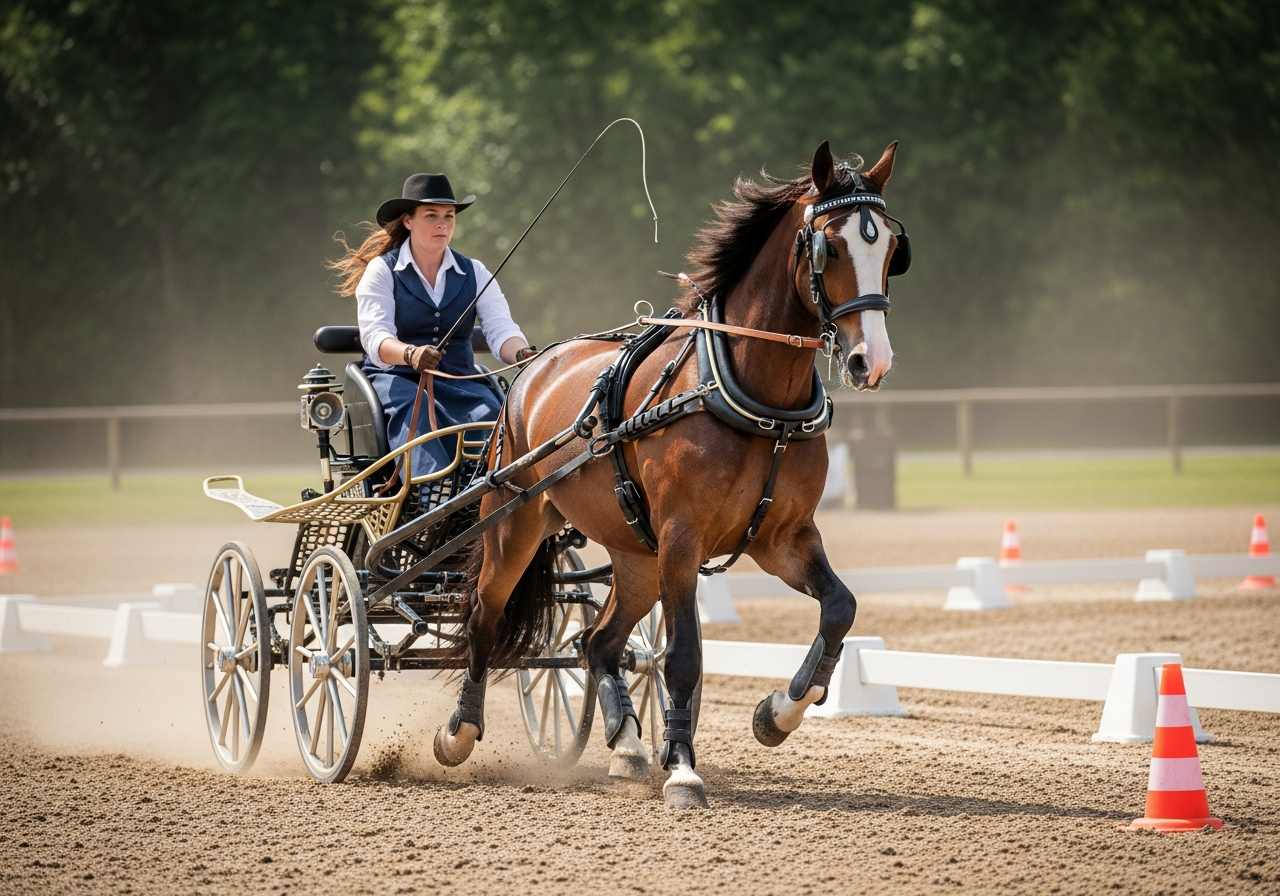
The final test of a combined driving event — precision, obedience and mental freshness after the exertions of the marathon.
The cones phase is the third and final phase of a combined driving event, held on the last day of competition. Often underestimated by newcomers to the sport, the cones phase is deceptively challenging — particularly because it is driven just 24 hours after the physical demands of the marathon, asking horse and driver to produce precision work when both may be tired and slightly sore.
The phase mirrors, in spirit, the showjumping phase of eventing: a horse that has proved its cross-country bravery must demonstrate that it can still perform with discipline and obedience when the pressure is on. A strong marathon performance can be undone by a careless cones round — making this final phase a critical part of competition strategy.
The width of the cone gates is precisely regulated by the rulebook. At BDS-affiliated events, cones must be set at a minimum of 30 centimetres wider than the widest point of the competitor's vehicle — which means the gap available to the driver narrows or widens depending on the size of their carriage.
This standardisation is designed to make the challenge equivalent across different vehicle sizes, but it does mean that drivers need to know their vehicle's exact track width (the distance between the outer edges of the wheels) to understand exactly how much room they have on each side as they pass between the cones.
Each pair of cones is topped with a ball — typically a brightly coloured tennis ball — which rests loosely in a cup on top of the cone. Displacing a ball counts as a penalty. This means a cone can be tipped slightly without penalty as long as the ball remains in place — but the margin is slim and confidence quickly becomes overconfidence.
Penalties in the cones phase are accumulated in two ways: knockdowns and time. Three penalty points are awarded for each ball displaced during the round. There is no additional penalty for knocking the cone itself — only the ball counts.
Time penalties are awarded for exceeding the maximum time allowed for the course. The allowance is calculated based on the length of the course and the prescribed speed (typically 200 metres per minute). Each second over the allowance attracts 0.5 penalty points.
Going the wrong way through a gate (error of course) incurs an automatic 5-penalty error, and the driver must return and correctly negotiate the gate before continuing. Course errors can be costly both in penalties and time, so memorising the course accurately is essential.
These are the attributes that consistently separate the clear rounds from the costly knockdowns.
The difficulty of the cones phase scales with the level of competition. At introductory and novice level, the cone width is set generously and the course is relatively straightforward — giving beginners the chance to experience the phase without being overwhelmed by the technical demands.
As you move up through intermediate and advanced classes, the cone widths reduce, the courses become more complex with tighter turns and more interweaving lines, and the time allowance becomes more challenging. At the top international level, the cones course is an extremely demanding technical exercise requiring exceptional horse-driver harmony.
This gradual progression makes combined driving accessible at every level — there is always the next challenge to work towards, but the entry point is genuinely welcoming to newcomers.