Regulations

Rules & Regulations

A clear overview of BDS and FEI rules — what you need to know before you compete in carriage driving.

Carriage driving competitions in the UK are governed by two sets of rules: the British Driving Society (BDS) rules, which apply to all BDS-affiliated domestic events, and the FEI (Fédération Equestre Internationale) rules, which apply at international competitions. For most UK drivers, BDS rules are the primary reference.

The rules cover every aspect of competition — the type and dimensions of vehicles permitted, the specification of harness and equipment, what drivers and grooms must wear, how penalties are calculated in each phase, and what constitutes an eliminated offence. They may seem daunting at first glance, but in practice the most relevant rules for newcomers are straightforward and your trainer will guide you through them.

How BDS Rules Are Organised

BDS rules are structured around competition levels, with introductory and novice levels having somewhat simpler and more permissive requirements than intermediate and advanced. This makes the sport genuinely accessible to newcomers while maintaining rigorous standards at higher levels.

At novice level, for example, cone widths are wider, dressage tests are simpler, and the marathon course is shorter with fewer hazards. Vehicle and harness requirements are also somewhat more relaxed — you do not need a show-quality turnout to compete at introductory level. As you progress through the levels, the requirements become more exacting in every respect.

The BDS also distinguishes between different classes based on the type of vehicle (two-wheeled vehicle vs four-wheeled carriage), the number of horses (single, pair, tandem, four-in-hand) and the size of horse (pony, horse). This means there is always a class appropriate to your specific combination.

Four Areas Every Competitor Must Know

These are the rule areas that most directly affect how you present yourself at a BDS-affiliated competition.

🛤
Vehicle Specifications
Vehicles must meet specific requirements including maximum track width (distance between outer wheel faces), minimum turning circle, and general condition and safety. Different rules apply to two-wheeled and four-wheeled vehicles. At presentation, the vehicle must be clean and in good repair.
👔
Harness Rules
Harness must be appropriate to the class — leather or leather-look synthetic is generally acceptable at novice level, but show classes require traditional leather harness in good condition. Harness must fit correctly and be safe. Specific rules apply to bearing reins, blinkers and collar vs breast collar configurations.
🥥
Dress Requirements
Drivers typically wear a traditional driving hat, gloves, apron and appropriate coat for dressage and cones. A safety helmet and body protector replace the traditional hat for the marathon phase. The groom must also be appropriately and safely dressed. Smart, traditional presentation is always appreciated.
📄
Course Rules
Specific rules govern how each phase must be navigated — gate sequences, time limits, the correct way to enter and exit arenas. Errors of course incur immediate penalties. Understanding the course rules for each phase, and practising the correct procedures, is an essential part of competition preparation.
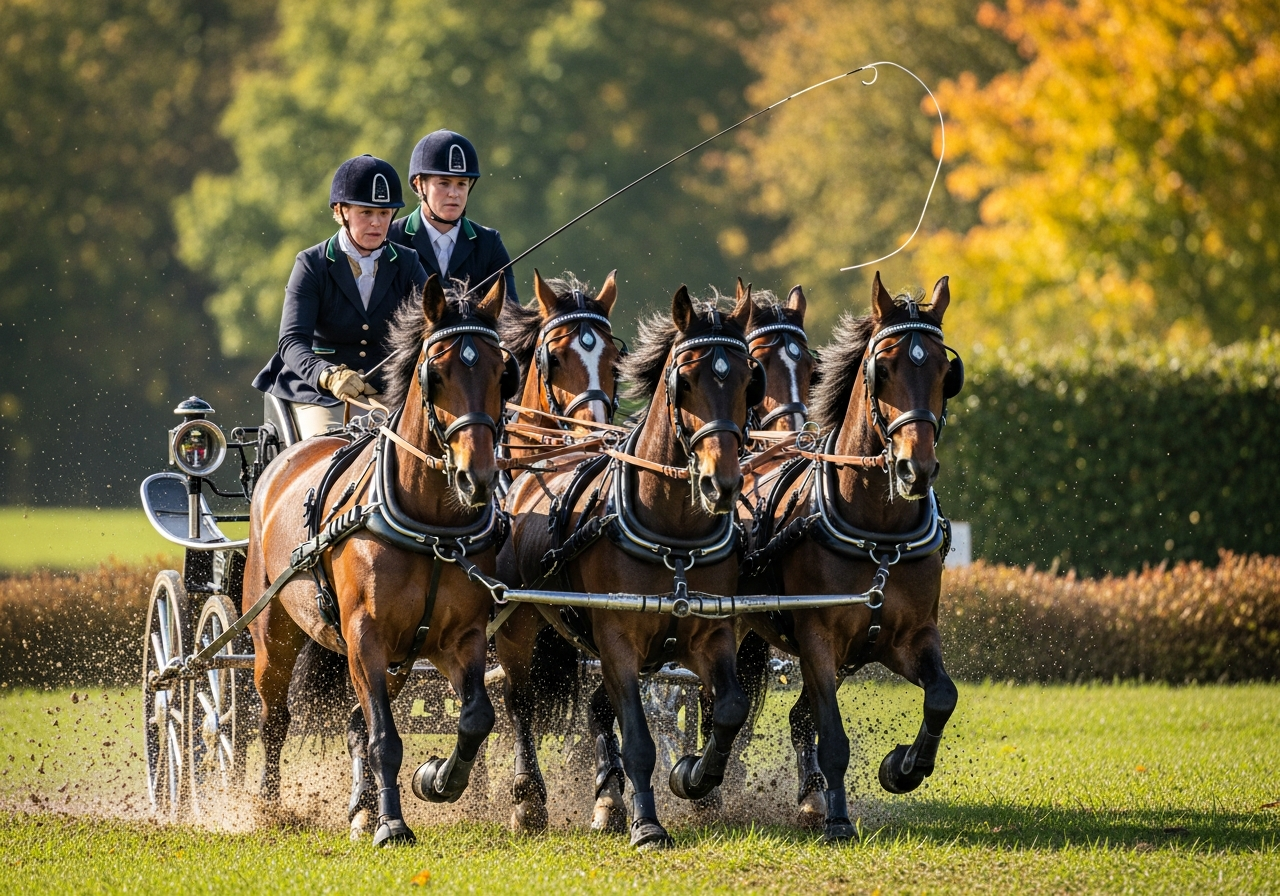
International driving competition
International Standards

FEI International Rules

The FEI publishes a comprehensive rulebook for international driving events that is updated periodically. FEI rules are broadly aligned with BDS rules but contain additional requirements for international competition — more specific vehicle dimension requirements, stricter dress codes and more detailed protocols for official inspections.

At FEI events, a technical delegate oversees compliance with all vehicle and harness regulations. A formal horse inspection (analogous to the vet inspection in three-day eventing) is conducted before competition begins, where horses must pass a soundness evaluation in front of the ground jury.

For drivers at UK club and national level, familiarity with FEI rules is not essential but is useful background knowledge, particularly if you have aspirations to progress toward international competition or if you attend FEI events as a spectator and want to understand what you're watching.

Rules Explained in Detail

Helmet Requirements +

A safety helmet meeting minimum standard PAS 015, VG1 01.040 or ASTM F1163 is compulsory for all drivers and grooms during the marathon phase. For dressage and cones, a traditional driving hat may be worn at lower levels, but many events now require helmets throughout. Check the specific requirements for each event you enter. Helmets must fit correctly and be free from damage.

Whip Rules +

The whip is a compulsory piece of equipment in all driving competitions — driving without a whip incurs penalties. The whip must be of appropriate length for the class (longer for four-in-hand, shorter for single horse). The whip is an aid, not a punishment — its use to strike a horse repeatedly or excessively may result in elimination. In dressage, the whip should be carried correctly and not used as a contact aid unnecessarily.

Groom Rules +

In combined driving, a groom is permitted (and in some classes required) to ride on the carriage. The groom must be securely mounted and must not make unauthorised dismounts during the marathon — doing so incurs penalties. In the dressage arena, a groom may ride if the driver chooses, but must maintain a correct position and not interfere with the horse's way of going. Grooms must wear appropriate safety equipment for the marathon phase.

Vehicle Width and Track Rules +

Vehicle track width (the distance between the outer faces of the wheels) is a critical measurement that affects cone gate widths, hazard gate widths and overall competition fairness. Before competing, measure your vehicle's track width precisely. This measurement must be declared at some events. The maximum permitted track width varies by class — check the current BDS rulebook for the specific limits applicable to your class.

Time Penalties Explained +

Time penalties apply in different ways across the three phases. In dressage, exceeding the time allowed incurs half a penalty per second over. In the marathon, time penalties apply for both exceeding the maximum time and for being significantly under the minimum time in some sections. In cones, exceeding the time allowance incurs 0.5 penalty points per second over. Understanding the time allowances and how to pace your round accordingly is part of competition preparation at every level.

What Results in Elimination? +

Elimination can be incurred for: three errors of course in a single phase; exceeding the maximum time allowance by a specified margin; the horse or vehicle falling; the driver leaving the carriage without permission; dangerous riding; cruelty or excessive use of the whip; failure to comply with equipment regulations; or a positive drug test (horse or human). Elimination is rare at club level but knowing what to avoid is important for all competitors.

Presentation Scoring in Showing Classes +

In showing and presentation classes (as distinct from combined driving), marks are awarded for the overall turnout — the appearance and condition of horse, harness, carriage and driver together. Judges assess cleanliness, correctness of harness fitting, the match between horse, vehicle and driver, and the general impression of harmonious traditional presentation. In these classes, the quality and condition of your equipment matters far more than in combined driving.

Where to Find the Current Rulebook

The BDS rules are updated periodically and the most current version is always available on the BDS website. Do not rely on older printed copies or second-hand information — rules do change, and competing under outdated information can result in avoidable penalties.

  • Visit the British Driving Society website for the current BDS rulebook (free to download)
  • Visit fei.org for the current FEI Driving rulebook
  • Check the specific schedule for each event you enter — events may have additional conditions
  • Ask your trainer if you're unsure about any rule's application in a specific situation

Road Driving Rules

Horse-drawn vehicles on public roads are subject to the Highway Code and the Road Traffic Act in the same way as other road vehicles. Drivers must obey traffic signals, give clear arm signals, use the correct road position and comply with speed limits where applicable. Horses and horse-drawn vehicles have the same rights as other vehicles on public roads (unless specific roads are designated no-horse routes). Carrying lights after dark is a legal requirement. It is your responsibility to know and follow these rules before driving on any public road.